Back to News

For decades, small-cap stocks occupied a distinct role in portfolios, providing exposure to earlier-stage companies and the opportunity to participate in the value creation that occurs as businesses grow and scale. Investors accepted higher volatility in exchange for access to businesses still climbing the maturity curve. A steady pipeline of IPOs replenished the asset class, and public shareholders captured much of the growth journey.
But the rapid rise of private equity—including venture capital, growth equity, and buyouts—has reshaped that dynamic. Businesses are staying private longer and a greater share of the value creation occurs before a company ever reaches the public markets. The result is a meaningful change in the opportunity set for public small cap equities and a new interpretation of how public and private markets function within portfolios.
Companies Are Staying Private for Longer
The growth of private capital has fundamentally altered financing pathways for young companies. With an estimated $3 trillion of private equity dry powder available for deployment in 2026, innovative companies can fund their entire growth journey without ever needing to tap public markets.
Historically, many firms accessed public markets at relatively modest market capitalizations, entering indices as small-cap constituents before graduating to mid- and large-cap benchmarks. Public investors were able to capture and benefit from that upward migration.
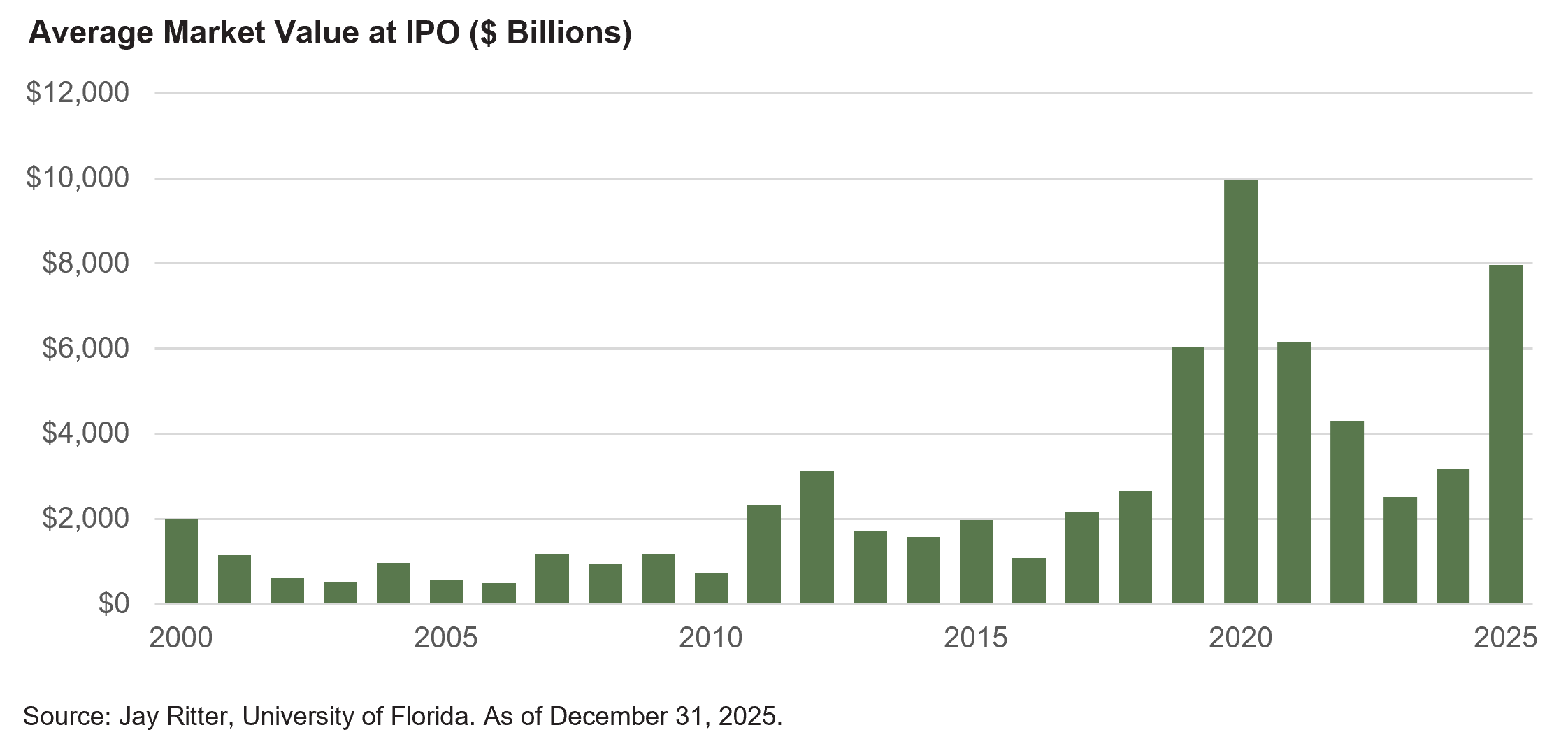
Today, if companies choose to go public, they are doing so much later and at far larger valuations. High-profile IPOs frequently debut with market capitalizations in the tens of billions, placing them directly into mid- or large-cap indices. Even smaller listings frequently exceed the thresholds that would populate traditional small-cap benchmarks. The practical effect is that much of the early-stage growth that once occurred in public markets is now captured in private portfolios.
A Different Composition of Risk and Return
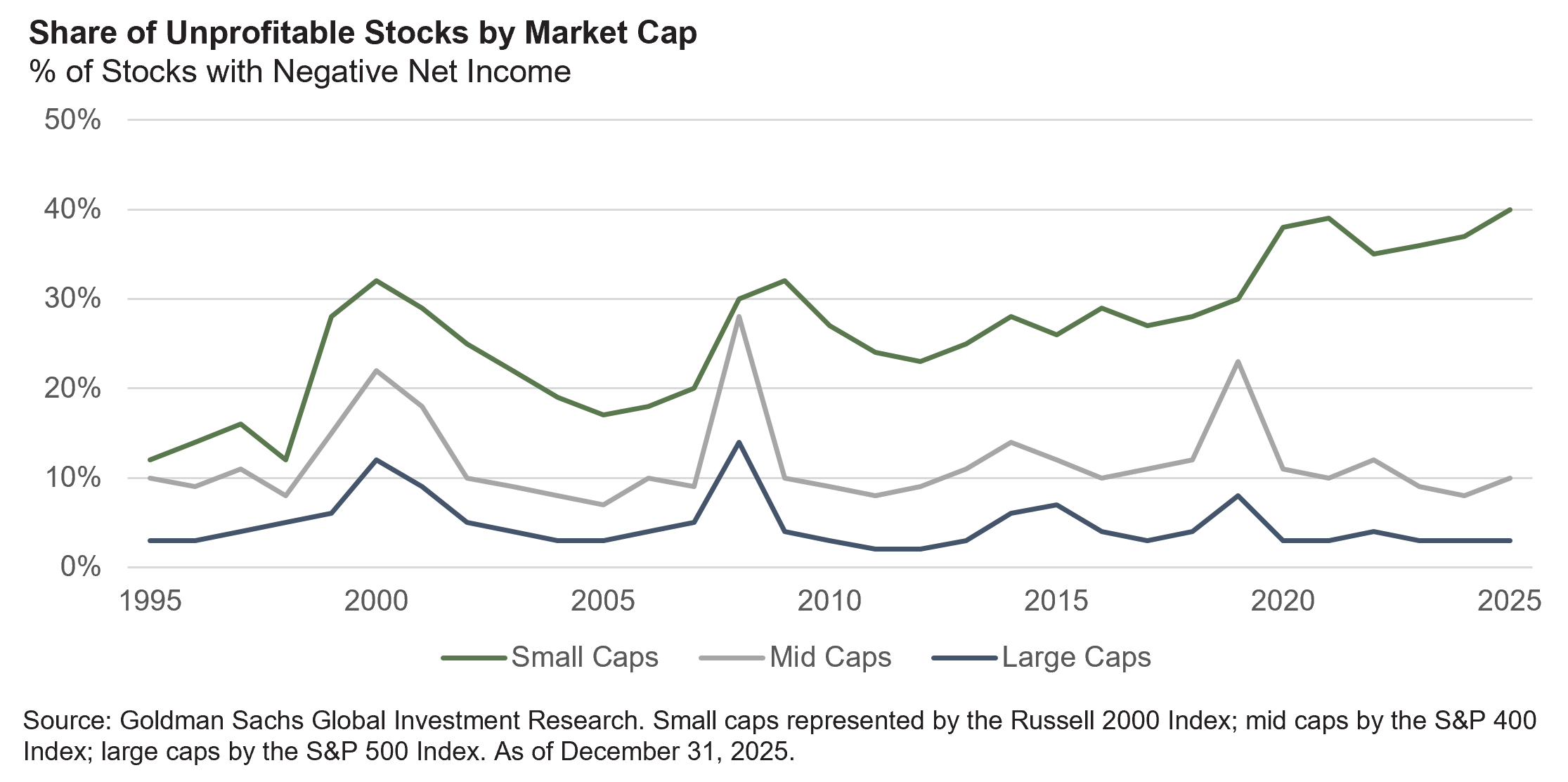
The implication for public markets is that fewer early-stage, high-growth companies are entering small-cap benchmarks. Many of the most dynamic firms either scale beyond small cap definitions before listing or remain private altogether. Meanwhile, a larger share of the existing small cap universe consists of businesses with weaker fundamentals. Approximately 40% of the Russell 2000—a proxy for the listed small cap universe—is now unprofitable, compared with a pre–Global Financial Crisis average closer to the mid 20% range. That shift potentially creates a meaningfully different risk/return profile than years past.
At the same time, M&A continues to shrink the investable universe. Private equity sponsors regularly take smaller public companies private, particularly in sectors characterized by growth and innovation. Over the past several years, private equity deal activity has been heavily concentrated in technology, healthcare, and consumer industries. Meanwhile, publicly listed small caps have become heavier in old-economy sectors, like regional banks, energy and utilities.
Collectively, these trends have produced a materially different small cap universe with a meaningfully altered sector mix, raising questions of whether the traditional small cap premium can persist in its historical form.
Reframing the Role of Public and Private Markets
None of this implies that small cap equities are irrelevant. They remain a liquid, transparent segment of the public markets and can offer compelling opportunities, particularly in periods of economic recovery. However, the dispersion across the quality spectrum within small cap benchmarks is near historical highs, reinforcing the importance of active management. As the fundamentals of the index have shifted structurally, passive exposure may no longer deliver the growth profile investors have historically come to expect.
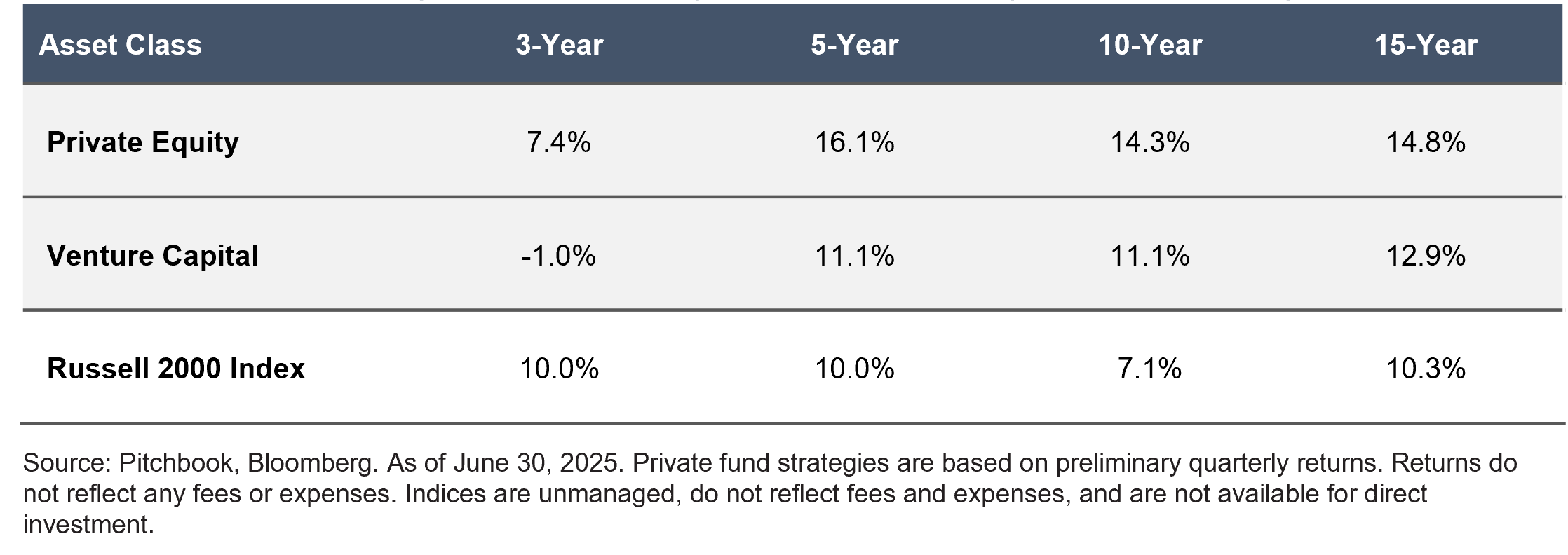
Across the private markets landscape, private equity increasingly represents the segment of the market where early-stage scaling and operational transformation occur. The democratization of the asset class, including improvements in fund structure and lower minimums in certain vehicles, have made the asset class more attainable for a wider range of investors than in prior cycles.
In this context, allocating to public or private markets for small company exposure is not an either-or decision. A well-constructed portfolio should incorporate both, pairing public equities with private equity exposure. Done thoughtfully, this approach can enhance risk-adjusted returns while restoring access to the segment of the corporate lifecycle that has increasingly moved out of the public markets.
Disclosures:
This material is intended for general informational purposes only. This should not be considered an individualized recommendation or personalized investment advice.
Investing involves risk, including loss of principal.
All expressions of opinion are subject to change without notice in reaction to shifting market conditions. Data contained herein from is obtained from what are considered reliable third-party sources. However, its accuracy, completeness or reliability cannot be guaranteed.
This information is not a specific recommendation, individualized tax, legal, or investment advice. Tax laws are subject to change, either prospectively or retroactively. Where specific advice is necessary or appropriate, individuals should contact their own attorney or tax to help answer questions about specific their specific situations or needs prior to taking any action based upon this information.
Download PDF
How Private Equity is Reshaping the Small Cap Landscape
Mar 18, 2026 | Insights
But the rapid rise of private equity—including venture capital, growth equity, and buyouts—has reshaped that dynamic. Businesses are staying private longer and a greater share of the value creation occurs before a company ever reaches the public markets. The result is a meaningful change in the opportunity set for public small cap equities and a new interpretation of how public and private markets function within portfolios.
Companies Are Staying Private for Longer
The growth of private capital has fundamentally altered financing pathways for young companies. With an estimated $3 trillion of private equity dry powder available for deployment in 2026, innovative companies can fund their entire growth journey without ever needing to tap public markets.
Historically, many firms accessed public markets at relatively modest market capitalizations, entering indices as small-cap constituents before graduating to mid- and large-cap benchmarks. Public investors were able to capture and benefit from that upward migration.
Today, if companies choose to go public, they are doing so much later and at far larger valuations. High-profile IPOs frequently debut with market capitalizations in the tens of billions, placing them directly into mid- or large-cap indices. Even smaller listings frequently exceed the thresholds that would populate traditional small-cap benchmarks. The practical effect is that much of the early-stage growth that once occurred in public markets is now captured in private portfolios.
A Different Composition of Risk and Return
The implication for public markets is that fewer early-stage, high-growth companies are entering small-cap benchmarks. Many of the most dynamic firms either scale beyond small cap definitions before listing or remain private altogether. Meanwhile, a larger share of the existing small cap universe consists of businesses with weaker fundamentals. Approximately 40% of the Russell 2000—a proxy for the listed small cap universe—is now unprofitable, compared with a pre–Global Financial Crisis average closer to the mid 20% range. That shift potentially creates a meaningfully different risk/return profile than years past.
At the same time, M&A continues to shrink the investable universe. Private equity sponsors regularly take smaller public companies private, particularly in sectors characterized by growth and innovation. Over the past several years, private equity deal activity has been heavily concentrated in technology, healthcare, and consumer industries. Meanwhile, publicly listed small caps have become heavier in old-economy sectors, like regional banks, energy and utilities.
Collectively, these trends have produced a materially different small cap universe with a meaningfully altered sector mix, raising questions of whether the traditional small cap premium can persist in its historical form.
Reframing the Role of Public and Private Markets
None of this implies that small cap equities are irrelevant. They remain a liquid, transparent segment of the public markets and can offer compelling opportunities, particularly in periods of economic recovery. However, the dispersion across the quality spectrum within small cap benchmarks is near historical highs, reinforcing the importance of active management. As the fundamentals of the index have shifted structurally, passive exposure may no longer deliver the growth profile investors have historically come to expect.
Across the private markets landscape, private equity increasingly represents the segment of the market where early-stage scaling and operational transformation occur. The democratization of the asset class, including improvements in fund structure and lower minimums in certain vehicles, have made the asset class more attainable for a wider range of investors than in prior cycles.
In this context, allocating to public or private markets for small company exposure is not an either-or decision. A well-constructed portfolio should incorporate both, pairing public equities with private equity exposure. Done thoughtfully, this approach can enhance risk-adjusted returns while restoring access to the segment of the corporate lifecycle that has increasingly moved out of the public markets.
Disclosures:
This material is intended for general informational purposes only. This should not be considered an individualized recommendation or personalized investment advice.
Investing involves risk, including loss of principal.
All expressions of opinion are subject to change without notice in reaction to shifting market conditions. Data contained herein from is obtained from what are considered reliable third-party sources. However, its accuracy, completeness or reliability cannot be guaranteed.
This information is not a specific recommendation, individualized tax, legal, or investment advice. Tax laws are subject to change, either prospectively or retroactively. Where specific advice is necessary or appropriate, individuals should contact their own attorney or tax to help answer questions about specific their specific situations or needs prior to taking any action based upon this information.
Download PDF